Here's the video story by Adam Waters, the man who tired of seeing his ugly body in the mirror and decided to change his life. Watch and get inspired!
Weight loss pills
Best natural weight loss pills
Sunday, November 11, 2007

Tuesday, October 9, 2007
Woman drops 110 pounds, 8 dress sizes
Three years ago Sharon Twitchell was miserable.

Carrying 227 pounds on her tiny 5'2" frame, the 51-year-old mother and wife could barely squeeze into her plus-size clothing.
Twitchell is the first of eight CNN.com I-Reporters who shared their weight loss stories with CNN. Over the next several weeks, we'll reveal their secrets, the defining moments that motivated them to lose a combined total of 1,167 pounds and how the weight loss has changed their lives.
"I was wearing a size 22 and getting my clothes at stores where the biggest size was a 24. I asked myself, 'Where are you going to buy your clothes after you get bigger than a size 24?'" said Twitchell.
Adding to her misery, Twitchell says her ballooning weight was also wreaking havoc on her 31-year marriage.
"We were literally just co-existing together, like roommates," recalled Twitchell.
"Friends asked my husband to e-mail them a picture of us. Later, I discovered that he had sent them an old photograph taken when I was much smaller. Even though he loved me, he was embarrassed at how much weight I had gained."
Afraid she would have to purchase clothing from online stores catering to larger women, Twitchell told her husband she'd had enough and was ready to make a change.
Don't Miss
Initially, Twitchell made an appointment with her physician in hopes that he would write her a prescription for a pill to help her lose weight. Instead, she says she saw the "w" begin to form on his lips and knew he was going to recommend she try Weight Watchers.
Uncomfortable with the thought of going to actual meetings, Twitchell lost 30 pounds on her own and eventually joined the online Weight Watchers POINTS program on October 26, 2004. She also bought an elliptical machine and a recumbent bicycle and started working out six days a week.
The pounds melted off.
Ten months and another 80 pounds later, she reached her goal weight on August 26, 2005.
Twitchell says she hasn't been this size since before her first daughter was born. She now weighs 117 pounds and wears a size 2 or 4, depending on the store.
How has this changed her life?
"I have a marriage again," says Twitchell, who recently retired and relocated with her husband from New Jersey to their new home in the mountains of western North Carolina.
"When I finally reached my goal (weight), my wedding ring was two sizes too big. I had already had it resized twice and the jeweler was hesitant that I might lose more weight. Rather than resize it, my husband bought me a new beautiful diamond ring and when he gave it to me he said this was a renewal of our wedding vows," she recalled.
Twitchell says her husband keeps telling people that he's got his wife back. This August, the couple will celebrate their 33rd wedding anniversary and they couldn't be happier.
"If I can lose 110 pounds, anyone can," says Twitchell.
Go to Proactol official site to read more success stories with Proactol!
Top weight loss pills
Natural weight loss pills reviews

Carrying 227 pounds on her tiny 5'2" frame, the 51-year-old mother and wife could barely squeeze into her plus-size clothing.
Twitchell is the first of eight CNN.com I-Reporters who shared their weight loss stories with CNN. Over the next several weeks, we'll reveal their secrets, the defining moments that motivated them to lose a combined total of 1,167 pounds and how the weight loss has changed their lives.
"I was wearing a size 22 and getting my clothes at stores where the biggest size was a 24. I asked myself, 'Where are you going to buy your clothes after you get bigger than a size 24?'" said Twitchell.
Adding to her misery, Twitchell says her ballooning weight was also wreaking havoc on her 31-year marriage.
"We were literally just co-existing together, like roommates," recalled Twitchell.
"Friends asked my husband to e-mail them a picture of us. Later, I discovered that he had sent them an old photograph taken when I was much smaller. Even though he loved me, he was embarrassed at how much weight I had gained."
Afraid she would have to purchase clothing from online stores catering to larger women, Twitchell told her husband she'd had enough and was ready to make a change.
Don't Miss
Initially, Twitchell made an appointment with her physician in hopes that he would write her a prescription for a pill to help her lose weight. Instead, she says she saw the "w" begin to form on his lips and knew he was going to recommend she try Weight Watchers.
Uncomfortable with the thought of going to actual meetings, Twitchell lost 30 pounds on her own and eventually joined the online Weight Watchers POINTS program on October 26, 2004. She also bought an elliptical machine and a recumbent bicycle and started working out six days a week.
The pounds melted off.
Ten months and another 80 pounds later, she reached her goal weight on August 26, 2005.
Twitchell says she hasn't been this size since before her first daughter was born. She now weighs 117 pounds and wears a size 2 or 4, depending on the store.
How has this changed her life?
"I have a marriage again," says Twitchell, who recently retired and relocated with her husband from New Jersey to their new home in the mountains of western North Carolina.
"When I finally reached my goal (weight), my wedding ring was two sizes too big. I had already had it resized twice and the jeweler was hesitant that I might lose more weight. Rather than resize it, my husband bought me a new beautiful diamond ring and when he gave it to me he said this was a renewal of our wedding vows," she recalled.
Twitchell says her husband keeps telling people that he's got his wife back. This August, the couple will celebrate their 33rd wedding anniversary and they couldn't be happier.
"If I can lose 110 pounds, anyone can," says Twitchell.
Go to Proactol official site to read more success stories with Proactol!
Top weight loss pills
Natural weight loss pills reviews
Friday, September 28, 2007
Would you lose weight for money?
People will lose weight for money, even a little money, suggests a study that offers another option for employers looking for ways to cut health care costs.
The research published in the September issue of the Journal of Occupational and Environmental Medicine found that cash incentives can be a success even when the payout is as little as $7 for dropping just a few pounds in three months.
Unlike providing onsite fitness centers or improving offerings in the company cafeteria, cash rewards provide a company with a guaranteed return, the researchers said.
"They really can't be a bad investment because you don't pay people unless they lose weight," said Eric A. Finkelstein, the study's lead author and a health economist at RTI International, a research institute based in nearby Research Triangle Park.
The study involved about 200 overweight employees at several colleges in North Carolina, divided into three groups. One group received no incentives while the other two groups received $7 or $14 for each percentage point of weight lost.
For example, someone in the middle group weighing 200 pounds who lost 10 pounds, or 5 percent, would get $35.
Participants didn't get any help on how to lose weight. In the end, employees who received the most incentives lost the most weight, an average of nearly 5 pounds after three months. Those offered no incentives lost 2 pounds; those in the $7 group lost about 3 pounds.
Those in the $14 group were more than five times as likely to lose 5 percent of their weight - the amount research has shown to be clinically significant, according to the study.
Finkelstein and co-authors Laura Linnan and Deborah Tate, professors at the University of North Carolina at Chapel Hill's School of Public Health, are currently analyzing data from a follow-up study that observed about 1,000 participants for a year. In that study, financial incentives were tested against a Web-based weight-loss program and changes in the office environment, such as healthier cafeteria food.
Linnan said more research is needed to determine the ideal dollar amount and whether incentives work in the long term.
"It's clear that one of the biggest challenges is to help people who lose weight keep the weight off," she said.
Plant worker Vonderahe Rivera said the financial incentives offered by her employer have helped her lose a total of 50 pounds and keep it off. Over the past five years, the O'Fallon, Mo.-based VSM Abrasives, which makes sandpaper, has been rewarding its 125 employees with cash for trimming their weight and an extra day off each year if they don't gain it back.
"The money is great and the day off is great," said the 51-year-old Rivera.
This year, she lost 25 pounds and got $125 when her employee team reached their weight-loss goal. She used the money for some new outdoor furniture. Being part of a group also keeps her motivated, Rivera said.
While there are some federal guidelines on offering cash incentives, the idea is relatively new and will likely require further study before many employers are willing to try such a program, said Dr. Jeffrey Dobro, a consultant with the human resources consulting firm Towers Perrin.
"To actually pay people for results is a little bit problematic ... if you don't give people an equal opportunity," he said.
To compensate, employers could offer similar incentives to staff who maintain a healthy weight, he said.
So far, the trend among larger companies has been to provide incentives for employees who do things like complete a health risk assessment or attend coaching sessions for weight management, said LuAnn Heinen, director of an institute that studies the costs and effects of obesity for the National Business Group on Health, which represents mainly Fortune 500 companies.
But Heinen said the study will be welcomed by employers who realize participation in other health programs remains low, or that they're paying for people to lose the same 10 pounds over and over again.
"I think over time companies will start looking for something with a little more teeth," she said.
Via www.wtopnews.com
Best weight loss pills reviews
How ProShapeRX helps you lose weight
The research published in the September issue of the Journal of Occupational and Environmental Medicine found that cash incentives can be a success even when the payout is as little as $7 for dropping just a few pounds in three months.
Unlike providing onsite fitness centers or improving offerings in the company cafeteria, cash rewards provide a company with a guaranteed return, the researchers said.
"They really can't be a bad investment because you don't pay people unless they lose weight," said Eric A. Finkelstein, the study's lead author and a health economist at RTI International, a research institute based in nearby Research Triangle Park.
The study involved about 200 overweight employees at several colleges in North Carolina, divided into three groups. One group received no incentives while the other two groups received $7 or $14 for each percentage point of weight lost.
For example, someone in the middle group weighing 200 pounds who lost 10 pounds, or 5 percent, would get $35.
Participants didn't get any help on how to lose weight. In the end, employees who received the most incentives lost the most weight, an average of nearly 5 pounds after three months. Those offered no incentives lost 2 pounds; those in the $7 group lost about 3 pounds.
Those in the $14 group were more than five times as likely to lose 5 percent of their weight - the amount research has shown to be clinically significant, according to the study.
Finkelstein and co-authors Laura Linnan and Deborah Tate, professors at the University of North Carolina at Chapel Hill's School of Public Health, are currently analyzing data from a follow-up study that observed about 1,000 participants for a year. In that study, financial incentives were tested against a Web-based weight-loss program and changes in the office environment, such as healthier cafeteria food.
Linnan said more research is needed to determine the ideal dollar amount and whether incentives work in the long term.
"It's clear that one of the biggest challenges is to help people who lose weight keep the weight off," she said.
Plant worker Vonderahe Rivera said the financial incentives offered by her employer have helped her lose a total of 50 pounds and keep it off. Over the past five years, the O'Fallon, Mo.-based VSM Abrasives, which makes sandpaper, has been rewarding its 125 employees with cash for trimming their weight and an extra day off each year if they don't gain it back.
"The money is great and the day off is great," said the 51-year-old Rivera.
This year, she lost 25 pounds and got $125 when her employee team reached their weight-loss goal. She used the money for some new outdoor furniture. Being part of a group also keeps her motivated, Rivera said.
While there are some federal guidelines on offering cash incentives, the idea is relatively new and will likely require further study before many employers are willing to try such a program, said Dr. Jeffrey Dobro, a consultant with the human resources consulting firm Towers Perrin.
"To actually pay people for results is a little bit problematic ... if you don't give people an equal opportunity," he said.
To compensate, employers could offer similar incentives to staff who maintain a healthy weight, he said.
So far, the trend among larger companies has been to provide incentives for employees who do things like complete a health risk assessment or attend coaching sessions for weight management, said LuAnn Heinen, director of an institute that studies the costs and effects of obesity for the National Business Group on Health, which represents mainly Fortune 500 companies.
But Heinen said the study will be welcomed by employers who realize participation in other health programs remains low, or that they're paying for people to lose the same 10 pounds over and over again.
"I think over time companies will start looking for something with a little more teeth," she said.
Via www.wtopnews.com
Best weight loss pills reviews
How ProShapeRX helps you lose weight
Friday, September 14, 2007
Weight loss success of a teacher

After Stacy Walker was told by her doctor she was a heart attack waiting to happen, the first thing she did was go to Starbuck's and order lemon pound cake and a hot chocolate.
"I just cried," Walker said. "I told my husband I had to do something."
Walker's doctor had prescribed pills to help aide the diet process, but she wanted to try Weight Watchers where she had previously had success.
"I was more than 200 pounds and five foot tall," Walker said.
Now, after about 40 weeks, the Stockwell Place Elementary School guidance counselor is a svelte size 6.
She said she gives a lot of the credit to the Weight Watchers program.
But even before she started the program, she tried a few things on her own.
"I gave up my habit of six cans of Coke per day and substituted them with 64 ounces of water daily, which I still do," Walker said.
"She's a Weight Watchers success story," said Stockwell Principal Tim Thompson, who works with Walker. "She looks great."
Walker followed the program and recorded her meals, drank the water and exercised 40 minutes, four days a week with a home cross trainer.
Now, she buys the Weight Watchers brand snacks and shares them with office members.
"I like the chocolate mint snacks," she said.
Besides losing her depression, Walker also found another health benefit.
She was diagnosed with plantar fasciitis and had to have surgery on her ankle, which made it hard to walk.
With the weight loss, she has been able to walk without pain.
"Don't get me wrong," Walker said. "I still get the occasional peanut butter dessert from Shane's, but now I do it in moderation."
It's also not an uphill process, she said.
"There were times when I gained a few pounds during the weight loss process," Walker said.
But, she said, it's now a way of life for me.
"I'm not the person I used to be."
How does her husband feel about her stunning weight loss?
"You know how men are," Walker said smiling.
Via www.shreveporttimes.com
Proactol weight loss
Natural weight loss pills review
Saturday, September 1, 2007
Weight loss success of Maggie Sorrells
No longer able to fit into a booth at a restaurant and too embarrassed to ask for seatbelt extensions on an airplane, Maggie Sorrells was desperate to lose weight.
The day she stepped on a hospital scale and realized she weighed 440 pounds she knew she had to do something.

Name: Maggie Sorrells
Age: 32
Hometown: Franklin, Tennessee
Occupation: Receptionist in doctor's office
Height: 5 feet 6 inches
Heaviest weight: 440 pounds
Current weight: 140 pounds
Pounds lost: 300 pounds
Defining moment
The moment I saw that I weighed as much as I did, it scared me, and I knew I had to do something about it.
How did you finally lose the weight?
Diet: Weigh Down Workshop, a faith-based weight loss program. I ate whatever I craved, but only when I was truly hungry, and then I ate a lot slower, so I could tell when to stop.
Exercise: Nothing out of the ordinary, occasionally I'd go for a walk, but never because I felt like I had to.
How long did it take you to lose weight?
Four years with two pregnancies within the same time period. One month after I lost 300 pounds, I became pregnant for the third time with my son.
How has this changed your life?
Drastically, the way I eat, the way I live my life. I am able to move better. I feel better emotionally and physically. I'm just a much happier person.
I love to hike and I could never go when I was big. I almost killed myself going a half-mile. My chest would hurt and I would think I was having a heart attack. Just after we had our daughter, we went hiking all day and climbed rocks.
I also love the beach. I'm no longer ashamed to go to the beach or wear a bathing suit.
Do you have any tips for other people who want to lose weight?
Yes, don't think about how much weight you have to lose because you'll get overwhelmed and discouraged. Set small goals, like 15 pounds. There were times I wanted to give up and there were days I felt like I couldn't do this. Food was my drug. Take [weight loss] in small increments because when you lose 15 pounds you'll be excited and before you know it you'll lose 50.
Perseverance is most important. If you mess up, especially in the beginning you're going to slip. Don't say, "I'll start over Monday." Start over right now. The worst enemy is if you give up. What got me to the end, to losing 300 pounds, was persevering. On days I wanted to eat the whole bowl of something -- I had to talk myself through it. The truth was, I really wasn't hungry. Food is so much better when you're hungry. Andy, my husband, eats what he wants to eat. But instead of eating an entire gallon of ice cream, he'll just have a scoop of ice cream.
Tips for quick healthy permanent weight loss
Best weight loss pills compared
The day she stepped on a hospital scale and realized she weighed 440 pounds she knew she had to do something.
Name: Maggie Sorrells
Age: 32
Hometown: Franklin, Tennessee
Occupation: Receptionist in doctor's office
Height: 5 feet 6 inches
Heaviest weight: 440 pounds
Current weight: 140 pounds
Pounds lost: 300 pounds
Defining moment
The moment I saw that I weighed as much as I did, it scared me, and I knew I had to do something about it.
How did you finally lose the weight?
Diet: Weigh Down Workshop, a faith-based weight loss program. I ate whatever I craved, but only when I was truly hungry, and then I ate a lot slower, so I could tell when to stop.
Exercise: Nothing out of the ordinary, occasionally I'd go for a walk, but never because I felt like I had to.
How long did it take you to lose weight?
Four years with two pregnancies within the same time period. One month after I lost 300 pounds, I became pregnant for the third time with my son.
How has this changed your life?
Drastically, the way I eat, the way I live my life. I am able to move better. I feel better emotionally and physically. I'm just a much happier person.
I love to hike and I could never go when I was big. I almost killed myself going a half-mile. My chest would hurt and I would think I was having a heart attack. Just after we had our daughter, we went hiking all day and climbed rocks.
I also love the beach. I'm no longer ashamed to go to the beach or wear a bathing suit.
Do you have any tips for other people who want to lose weight?
Yes, don't think about how much weight you have to lose because you'll get overwhelmed and discouraged. Set small goals, like 15 pounds. There were times I wanted to give up and there were days I felt like I couldn't do this. Food was my drug. Take [weight loss] in small increments because when you lose 15 pounds you'll be excited and before you know it you'll lose 50.
Perseverance is most important. If you mess up, especially in the beginning you're going to slip. Don't say, "I'll start over Monday." Start over right now. The worst enemy is if you give up. What got me to the end, to losing 300 pounds, was persevering. On days I wanted to eat the whole bowl of something -- I had to talk myself through it. The truth was, I really wasn't hungry. Food is so much better when you're hungry. Andy, my husband, eats what he wants to eat. But instead of eating an entire gallon of ice cream, he'll just have a scoop of ice cream.
Tips for quick healthy permanent weight loss
Best weight loss pills compared
Friday, August 31, 2007
Weight loss success of Andy Sorrells

He says he started without a specific goal weight and reduced his portion sizes to lose 280 pounds.
Name: Andy Sorrells
Age: 29
Hometown: Franklin, Tennessee
Occupation: Loan Processor
Height: 6 feet 3 inches
Heaviest weight: 500 pounds
Current weight: 220 pounds
Pounds lost: 280 pounds
Defining moment
My wife, Maggie, had started the Weigh Down Workshop program. We were newlyweds and continued to gain weight. We had tried other diets but this one worked for us.
How did you finally lose the weight?
Diet: Weigh Down Workshop, a spiritually based weight loss regimen. I just started without a real goal of losing a specific amount of weight and reduced my portion sizes. I spent so much of my life thinking about it and planning for it. Finally, I stopped focusing on food, stopped counting calories and eating low-fat foods. You just have to eat what your body craves and reduce portion sizes.
Exercise: I didn't really exercise. I walked occasionally but I never followed a specific fitness regimen.
How long did it take you to lose weight?
Just about 17 months from January 2003 to May 2004. My wife had tried the Weigh Down Workshop and had success with it. I was trying diet foods and fat-free foods. But I knew there had to be a way someone could eat normal food and still lose weight.
How has this changed your life?
When I was born I was close to 11 pounds and all of my life I've dealt with weight issues. People always teased me about being overweight. Once I started this program, I realized that I had to stop being angry at the world and I needed to look internally.
Once I started this program, it changed my outlook on my entire life. I realized that being happy is a choice. I can either be filled with hate and despair or I can be happy and help others.
Do you have any tips for other people who want to lose weight?
It is more than a temporary change. It's a lifestyle. Open your eyes and see that there's more to life than food. Food is used as a comfort, but just like alcohol or anything else, it can be overused. Eat smaller and be content.
Via http://www.cnn.com/2007/HEALTH/diet.fitness/07/23/weightloss.andy.sorrells/index.html#cnnSTCText
Wednesday, August 29, 2007
Weight loss success story of Sorrels family - 580 pouns off
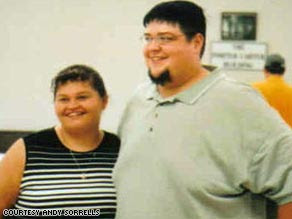
When Maggie Sorrells looks at her husband, Andy, she doesn't see the man she married. In fact, most days, she doesn't even recognize herself.
Before the Franklin, Tennessee, couple met online, both had endured lifelong struggles with weight and emotional overeating. Together, they had a combined weight of nearly 1,000 pounds.

Maggie, who had a family history of heart disease and diabetes, had been warned by her doctor at the age of 27 that she wouldn't live to see 30. But her real moment of truth came when she visited her mother in the hospital.
"The biggest shock of my entire life was stepping on a hospital scale and realizing I weighed 440 pounds," she recalls.
Until that moment, Maggie says she never knew how much she weighed, because she was too heavy to register on a household scale.
Andy, like Maggie, tried countless diets but failed to keep the weight off. At his heaviest, he was 505 pounds and had to have most of his size 64 clothing made by his mother to fit his 6-foot-3-inch frame.
Maggy, on the other hand, tried to conceal her misery by making other people laugh.
"I was so depressed and so miserable. I was always the funny fat girl, but on the inside I was miserable," recalls Maggie. "It held me back in many ways and I started to accept it as being genetic and felt this was just the way I was going to be."
Though she never let her obesity keep her from traveling or socializing, it had affected her quality of life. Maggie had to use a seatbelt extension on airplanes and was once asked to get off a roller-coaster at an amusement park.
In August 2002, the couple was married and they soon made a decision that would forever change their lives.
Before getting married, a friend introduced Maggie to The Weigh Down Workshop, a faith-based weight loss program, which teaches people to conquer their addiction to food, as well as other substances and vices, by turning to God.
Maggie says she was never consistent or committed enough to stick with the program. But shortly after their wedding, the couple started packing on the pounds and while Andy tried another diet, Maggie gave Weigh Down another try.
"At the end of 2002 and the beginning of 2003, I called Weigh Down and started taking the classes," says Maggie. "My whole life, I had always wanted somebody to [lose weight] with me. But I knew if I wanted it bad enough, I would have to do it alone."
She began to lose weight.
"I ate whatever I craved, but only when I was truly hungry and then I ate a lot more slowly, so I could tell when to stop," Maggie says.
In February 2003, after seeing his wife's results, Andy stopped counting calories, gave up the low-fat foods and reduced his portion sizes. Fifteen months later, he had lost 257 pounds.
"Once I started this program, it changed my outlook on my entire life. I realized that being happy is a choice. I can either be filled with hate and despair or I can be happy," says Andy, who realized he no longer needed the anti-depressants.
Maggie's weight loss was more gradual. Shortly after starting the program, Maggie became pregnant with the couple's first child. Sadly, she lost the baby when she was seven months pregnant.
"Many of our family members were afraid that we would turn back to food after we lost our first daughter, since we had turned to food to solve our problems our whole lives," remembers Maggie.
Faith, she says, helped her overcome the loss and continue on the program. Three years later, she had not only lost 300 pounds but she also gave birth to another daughter, Lily. Last week, the couple welcomed their son, Jacob.
How has the weight loss changed their lives? Maggie, who now weighs 140 pounds and wears a size six, and Andy, who weighs 220 pounds and wears a size 36, say they had no idea their lives could be this good.
"It blows my mind that we look the way we do," says Maggie.
The couple shares their success and strategy for weight loss by leading online classes for Weigh Down. Maggie believes if just one person's life can be changed by her story then her struggle will have been worth it.

"I want people to know there is hope. I looked for hope my whole life," says Maggie. "I want that person who is just like the old me to look at where I am now and know that you want to be here!"
Via http://www.cnn.com/2007/HEALTH/diet.fitness/07/23/weightloss.sorrells/index.htmlWeight loss pills that work
Subscribe to:
Posts (Atom)


